

Bringing Psyche Back to Psychiatry
with Paul Minot MD
How Will the Future Judge Modern Psychiatry?
Featured Article

I’m 71 years old, and I’ll begin reducing my work hours with an eye toward eventual retirement. That doesn’t mean I’ll stop thinking, or stop writing, so don’t get your hopes up. I’d like to leave a belated mark on history, and my neurodigital hypothesis is probably my best chance to do so.
But I’m much more certain that this era of psychiatric practice is going to leave a mark on history, and it won’t be a favorable one. It will be remembered as a time when we made dramatic incursions into the treatment of the human brain-mind–the most complicated object in the known universe–in the absence of any scientific knowledge of how thought works, or what constitutes the mind. It will be remembered as a time when our most precious commodity was treated like it was just a very complicated gland, and bombarded with medications. In the absence of that crucial physiological understanding of how our brain actually does its work, we’ve used our trade association (what the #%*&@~??!!!) to construct artificial diagnoses, so they would be available to provide “indications” for the peddling of commercial products. The contaminated process in which we’ve done so will be a stain on our reputation.
I’m not saying that we should not have made any attempts to classify psychiatric disorders. But what is absent is any appropriate level of humility, given the fact that this process is not the revelation of scientific truth, but the creation of a fantasy world of ersatz “diagnoses,” necessary because of our persistent ignorance of neuropsychological physiology. This is done to direct treatment, of course–but also to feed our egos, and fatten our wallets. The result is an empty conviction that we are knowledgeable, when in fact we are damn near as absurdly ignorant as we have always been. We don’t know how thought is generated–and it seems like we don’t at all care if we do or don’t know it. We don’t know how the mind works, so we pretend it doesn’t exist–probably because the fact of its existence is a constant reminder that we really don’t know what the hell we’re doing. But I can tell you what we are doing, and what we aren’t doing.
Ironically, psychiatrists are always dropping the word “science” when we’re touting the effectiveness of our available treatments–which isn’t science at all, but technology. Science is the study of nature, not the evaluation of technological efficacy. I sincerely believe that our blurring of “science” and “technology” is no accident, but has an unstated purpose. We dearly want our mastery of technologies to stand in for our profound ignorance of the nature that we are treating.
Do you need some proof? The most well-known psychiatrist in America is Dr. Daniel Amen, whose trademark gimmick is displaying SPECT scans on television, with the implication that this is somehow cracking the code of thought. SPECT scans measure the activity, metabolism, and blood flow of internal organs and tissues, including the brain. But these coarse measures of activity don’t at all reveal to us the molecular processes that underlie thought. The ethereal content of thought and mind remains a mystery.
As much as we know about the brain nowadays, we still haven’t cracked the code of thought, nor even established the medium of the code. In 2022 I went out on a scientific limb, and proposed that the brain could be utilizing RNA and/or DNA to store memory as digital data–and could be generating thought by executing digital processing like our computers do. I cited neuroscientific studies that supported this hypothesis, providing sufficient evidence to have it peer-reviewed and published on the cover of Psychiatric Times, which was then disseminated to 50,000 psychiatrists in the United States and Canada.
The article generated no letters to the editor, nor did I receive any personal contact from my peers–not even hostility or disagreement. The most likely explanation is that none of those psychiatrists were at all interested in contemplating the nature of thought and memory–since it has no evident impact on what medication they were going to prescribe, or what other treatment they were going to contemplate. In other words, business is fine just as it is. Perhaps we don’t want to contemplate any prospective scientific knowledge that might derail this gravy train.
In fact, discovery of the physiological nature of thought and mind could indeed derail the gravy train. Modern psychiatric treatment is acceptable as a standard of care, because we have a scientific understanding of neurotransmitters–but we don’t understand thought. Or emotion. Or memory. But if you press a modern psychiatrist hard enough, they’re likely to give you a one-word explanation for everything that can’t be otherwise explained: neuroplasticity.
Just google “neuroplasticity,” and the AI will go overboard telling you about all the ways that neuroplasticity could explain the functions of the brain that we can’t otherwise explain. But if you google “neuroplasticity dubious,” Google AI will report the numerous ways that neuroplasticity is being exploited as an explanation for everything that we can’t explain–literally debunking much of what the previous Google results just told you. I’ve found that it’s difficult to dissuade a true believer in neuroplasticity, because they so love trotting out metaphors like “rewiring” and “circuitry” to feel like they know exactly what they’re talking about–having apparently received a beloved Snap-Circuit kit on their eighth birthday. (My perception is that this really does seem to be a guy thing.)
There is no doubt whatsoever in my mind that neuroplasticity is a real thing. For example, I utterly believe that neuroplasticity could explain the muscle memory of a musician or athlete. But I refuse to believe that it does everything, and particularly doubt that it is responsible for thought. To be honest, it’s in part because the relationship of the mind to the brain seems to me so highly evocative of the relationship of software to hardware in our computers.
The most instinctive rebuttal to this digital proposal is that nature couldn’t possibly have the technological know-how to implement digital processing–which seems sensible enough, until you take a broader look at what has happened. Yes, man invented the computer. But we didn’t invent digital processing–we discovered it. We didn’t alter those ones and zeros to make them functional–we discovered what ones and zeros already had the capacity to do, and then put them to work. We’ve since discovered that quaternary codes work just as well as binary codes, and would reduce the number of digits necessary for code. Binary just happens to be our established industry standard. And by the way–nature invented man, which is a helluva lot more complicated than any computer we’ve ever devised.
But notably, nobody contacted me to tell me I was full of shit either. So if it wasn’t disbelief, it was likely utter disinterest. But why would psychiatrists be disinterested in a hypothesis to explain thought and mind? Well, being a psychiatrist myself, I can think of a few reasons.
First of all, let’s note that ever since psychiatrists decided in the 1980s to turn our backs on the minds and thoughts of their patients, we have financially thrived in a manner unimaginable to our predecessors–and have at last become regarded as real doctors. Both would explain why psychiatrists would have little interest in revisiting “thoughts” or “minds.” And such fears might even be warranted, because I’ll admit it: I proposed this neurodigital hypothesis to challenge modern psychiatry’s current business model, which came into being with psychiatry’s utter dismissal of the psyche–the mind, soul, and spirit of man.
I can’t explain why it is that I was apparently the first person to formulate this hypothesis, except for the fact that I went looking for it. And I never could have imagined that it would be published on the front page of a tabloid dispensed to 150,000 psychiatrists. But it stuns me that it might have made much more of an impact on a different set of 150,000 readers. Like me, the editorial staff probably assumed that psychiatrists would be much more interested in the subject than they actually were.
In my book How Psychiatry Lost Its Mind, I cite three “epic fails” of modern psychiatry. One of those failures was the release of the CDC Suicide Study in 2018, which revealed that from 1999 to 2016–a period in which more Americans were diagnosed with psychiatric problems, and prescribed psychiatric medications, than ever before–the rate of suicide in the United States had increased by 30%. But what was even more notable than this awful public health disaster was the response provided by the leadership of American psychiatry–a bland collection of brief comments from our psychiatric leadership that were obviously crafted to draw as little public attention as soon as possible, and to end the discussion as soon as possible. As planned, this news item was quickly buried in the news cycle by the antics provided by the first Trump administration. No meaningful response to this epidemiological failure was ever to be provided by American psychiatry–even when it had become a 35% increase in suicide three years later.
But another of those three “epic fails” that I cite in my book says even more about the cracked mindset of modern psychiatry. That is the chapter in which I recount the death of Rebecca Riley–a 4 year-old toddler in Boston who was in psychiatric care, and in 2006 died from an overdose of psychiatric medications. She was growing up with an ill-tempered father, and a weakly submissive mother, in a very dysfunctional home environment. Rebecca was unfortunately growing up when the most esteemed and most published psychiatrist of the era was Dr. Joseph Biederman. Dr. Biederman was not only the Chief of the Clinical and Research Programs in Pediatric Psychopharmacology and Adult ADHD at the Massachusetts General Hospital, and a professor of psychiatry at Harvard Medical School. He was the most cited psychiatric authority of his time. Biederman drew upon his acclaim to promote his own diagnostic invention–pediatric bipolar disorder, a diagnosis applied to children with erratic moods and mood instability, extending even to toddlers. This drew upon the template of adult bipolar disorder, and justified the administration of mood stabilizing medications, and even antipsychotic medications, to control mood instability in this juvenile patient population.
But on December 13, 2006, police responded to an early morning emergency call from a suburb of Boston, and found a 4-year-old girl dead on the floor next to her parents’ bed, after an overdose of psychiatric medications had been administered by her mother. This death came to the attention of the nation at large, and those in the public who had any common sense came to the conclusion that prescribing psychiatric medications to control mood instability in a toddler is stupid–because mood instability is normal in a toddler, and the common remedies applied are nurturance, redirection, and personal growth.
Nowadays, it seems quite clear that mood instability in children can respond positively to growth, and that such growth is to be expected in children. But our idiotic embrace of a diagnosis and medications to address mood instability in children says a lot about modern psychiatry’s prevailing mindset. Most of the public at large understands that children have the capacity to grow and improve themselves over time. But somewhere along the way, psychiatry became so intoxicated with their own treatment model that they decided to impose it on toddlers.
I believe that this same erroneous mindset is being imposed on many of our adult patients as well. Many adults are capable of personal growth, but modern psychiatry has little inclination to promote such growth. That’s because doing so would be entirely inconsistent with our business model, which is financially sustained by the utilization of psychiatric medications.
The psychological growth of children is attained to a large degree by the acquisition of wisdom over time. That’s why wisdom is implicitly associated with age, and the psychological growth that accompanies it. But modern psychiatry makes no concerted effort to incorporate wisdom into our practice–despite its long history of helping us human beings to regulate our moods, and accommodate to the various challenges of life.
The guiding purpose of my formulation of the neurodigital hypothesis was not just to exercise my imagination, or to get myself published for something or other. It was to find a scientific explanation that would confirm the mind’s existence–so that it would no longer be neglected by psychiatry at large, as it is today. We all constantly experience our own minds, and the minds of others–but modern psychiatry is nonetheless in an utter state of denial regarding its existence, or its utility. Modern psychiatry doesn’t just cope with our ignorance thereof–it financially and intellectually exploits that ignorance. Can anyone argue that our current treatment model isn’t mindless?
But ignorance doesn’t have an infinite shelf life. Sooner or later, the scientific world is either going to accept my hypothesis to explain the physiology and existence of the mind, or find another better hypothesis that has more evidence to support it. The mind and thought do exist, and will eventually be explained. Whenever that happens, I believe that modern psychiatry is going to look pretty ignorant, quite corrupt, and certainly mindless.
What’s Brought Me Here
I trained in psychiatry in the early 1980s, at the dawn of the current biological era of psychiatry. I was fortunate enough to receive psychotherapy training, but since my graduation in 1985 I’ve been practicing modern medication-oriented psychiatry. Over the past four decades I’ve seen revolutionary improvements in psychiatric medication, including the advent of atypical antipsychotics, SSRIs and other modern antidepressants, and anticonvulsant medications for mood stabilization. All these innovations occurred in an atmosphere of promise, driven by the belief that we were finally cracking the code of psychiatric dysfunction, improving lives and beating mental illness.
Forty years later, we’ve seen an explosion of psychiatric diagnoses and treatment. Numerous psychiatric terms have migrated into popular jargon, such as “bipolar”, “chemical imbalance”, “PTSD”, “ADHD”, and “autistic spectrum disorder”, and drug names like Prozac and Ritalin. With more people carrying psychiatric diagnoses and receiving treatment than we ever could have imagined, you would expect to see improved psychiatric health and decreased suicide…but the opposite has occurred. The percentage of Americans on psychiatric disability benefits more than doubled from 1987 to 2007. And from 1999 to 2018, in the midst of this Age of Prozac, the incidence of suicide in America increased by 35%.
This shit is not working.
The biological movement opened the door to billions of dollars of investment from the pharmaceutical industry, for research and development of new psychiatric drugs by the academic centers of psychiatry. It’s been good for the insurance business as well, since the model justifies shorter hospitalizations, and limits access to time-consuming psychotherapies.
My mission here is to confront the corrupted scientific reasoning that props up this biological model, and to promote a more eclectic model of treatment–one that acknowledges the existence of the mind as well as the brain, and engages our capacity for personal growth.

About Me
I grew up an only child and an Air Force brat. My Dad retired and we settled in Houston, where I easily transitioned to NASA brat for junior and senior high school. I majored in Biology and minored in Social Sciences at Rice University. I pursued both medical school and psychiatric residency at the University of Texas Health Science Center at San Antonio, completing my training in 1985. (Check out the podcast/article “My Insecure Profession” if you want to hear more about that experience.) Soon afterward I spent 11 years working in Austin, mostly in community psychiatry. I subsequently spent four wonderful years practicing frontier psychiatry (it’s a thing) in the Big Bend area of Texas.
I’ve now been practicing psychiatry since 1985, and since 2001 have been employed by MaineGeneral Health in Augusta, Maine. My wife Aimee is a psychiatric nurse (as was my late mother), and together we have five wonderful children. I also have a backstory of playing bass in a number of Texas bands who recorded original music–most notably a stint with The Hates, proclaimed to be “Houston’s first and last punk band.”
My Podcast
My Book
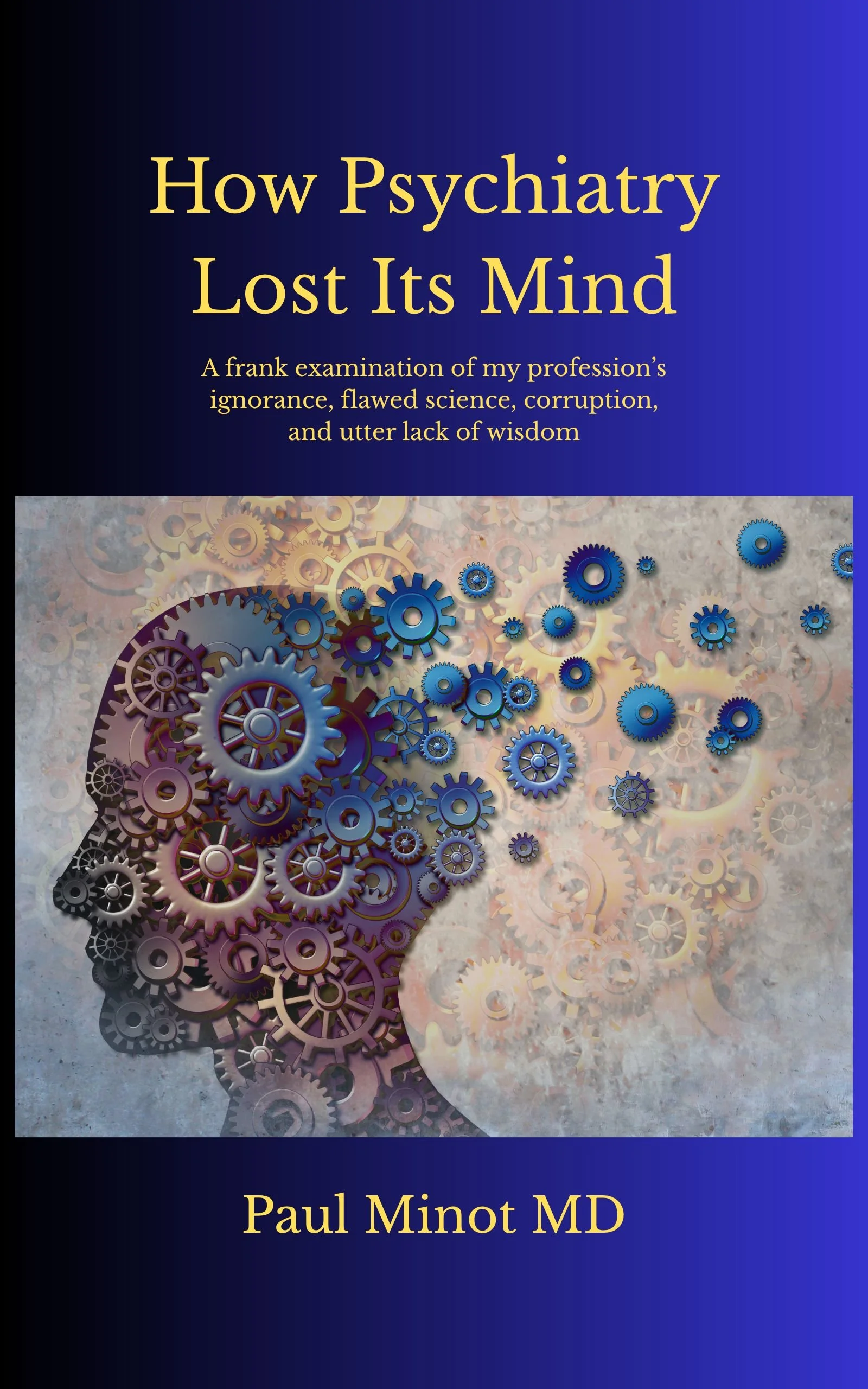
After 40 years of clinical practice, I’ve written this book to inform the general public of psychiatry’s stunning level of scientific ignorance, and the immense body of deceptive pseudoscience it has manufactured in order to compensate for that ignorance. This illusion has been created not only to fool the public, but also to fool ourselves. I also review three astounding psychiatric failures that expose my profession’s foolishness, irresponsibility, and cowardice. I go on to offer a revolutionary neurodigital hypothesis to ponder, which might explain the nature of thought and the mind…peer-reviewed and published, but neglected by psychiatry at large.

If you don’t get what you want, you suffer; if you get what you don’t want, you suffer; even when you get exactly what you want, you will still suffer because you can’t hold onto it forever. Your mind is your predicament. It wants to be free of change. Free of pain, free of the obligations of life and death. But change is law, and no amount of pretending will alter that reality.
-Socrates